Tonight! How to See the Solar Eclipse from Gran Alacant
Something rather extraordinary is happening over Spain tonight.
On the evening of Wednesday, 12 August 2026, the Moon will pass between the Earth and the Sun, creating the first total solar eclipse visible from mainland Spain in more than a century. Gran Alacant isn't quite inside the narrow path of totality, but don't feel too cheated. Here in the Santa Pola area, the eclipse will reach a magnitude of approximately 99%. That is going to be quite a sight. So, if you haven't already, find yourself a good viewing spot, get your eclipse glasses ready and put something cold in the fridge. Here's our last-minute Gran Alacant guide to tonight's eclipse.
First things first: what exactly are we looking at?
A solar eclipse happens when the Moon passes directly between the Earth and the Sun. The Moon is, of course, enormously smaller than the Sun. But by a remarkable coincidence, the Sun is also about 400 times farther away from us than the Moon. From Earth, the two therefore appear almost exactly the same size in the sky. When their paths line up just right, the Moon can cover the Sun.
People inside the relatively narrow path of the Moon's darkest shadow experience a total solar eclipse. For a few astonishing moments, the bright face of the Sun disappears completely and the solar corona, the Sun's outer atmosphere, becomes visible. Gran Alacant lies just south of that path, so we will experience an extremely deep partial eclipse instead. At maximum, only a tiny sliver of the Sun will remain visible.
And that distinction is extremely important when it comes to your eyes.
What time is the eclipse in Gran Alacant tonight?
The official timetable from Spain's Instituto Geográfico Nacional for nearby Santa Pola gives us an excellent guide:
- Eclipse begins: 19:40
- Maximum eclipse: 20:35
- Eclipse magnitude: approximately 99%
- Sun height at maximum: only about 4° above the horizon
- Direction: west-northwest
- Sunset: approximately 21:00
Don't wait until 20:30 to go outside. The eclipse begins almost an hour before maximum and watching the Moon gradually move across the Sun is half the fun.
Because the Sun will be so low in the sky at maximum, WHERE you watch is almost as important as when.
Where should you watch it?
You need a clear view towards the west-northwest. This is one occasion when simply heading for the beach may not necessarily give you the best view. The eclipse is happening close to sunset and the Sun will be very low over the western horizon. Gran Alacant's elevation could work very much in our favour. Look for an open, elevated spot where buildings, trees or hills don't block your view towards the setting Sun. If you already know where you can normally see a good sunset from Gran Alacant, that's probably an excellent place to start.
And remember that a lot of other people will have exactly the same idea. You don't need to drive halfway across the province or balance yourself precariously on a cliff edge to see this. Pick somewhere safe, arrive early and enjoy it.
VERY IMPORTANT: protect your eyes
This is the bit we really don't want anyone to skip. Never look directly at the Sun without proper solar eye protection. And because Gran Alacant will experience a partial eclipse rather than totality, there is NO point during tonight's eclipse when it will be safe to remove your eye protection and look directly at the Sun. Even when approximately 99% of the Sun is covered, that remaining sliver is still intensely bright.
Use proper eclipse glasses or a handheld solar viewer designed for viewing the Sun. Safe solar viewers should comply with the ISO 12312-2 international safety standard. Ordinary sunglasses are not enough. Two pairs of sunglasses are not enough. Neither are smoked glass, CDs, old photographic film or whatever ingenious solution somebody's uncle has posted on Facebook.
Check your eclipse glasses before using them and don't use them if they are scratched, torn or damaged. And please supervise children carefully.
One more important warning: never look through binoculars, a telescope or a camera lens while wearing eclipse glasses. Magnifying optics concentrate the Sun's rays and require their own properly fitted solar filter on the FRONT of the equipment.
No glasses? You can still join in. A simple pinhole projector allows you to watch an image of the eclipsed Sun indirectly without looking directly at it. Even the gaps between leaves on a tree can act as hundreds of tiny pinhole projectors. Look at the ground during the eclipse and you may see lots of little crescent Suns.
What will it actually feel like?
This is where things get interesting. Because almost all of the Sun will disappear, the light around us should become distinctly strange as maximum eclipse approaches. It won't become completely dark in Gran Alacant because we are not in the path of totality, but expect the evening light to fade dramatically. Shadows may look sharper and peculiar. The temperature may dip. Birds and insects may react to the sudden change in light.
And because this eclipse is happening so close to sunset anyway, the whole thing should have a particularly atmospheric quality. Maximum occurs at around 20:35, but don't wander outside at 20:34 expecting the whole performance to happen in sixty seconds. Watch the progression. That's half the fun.
What about the dog?
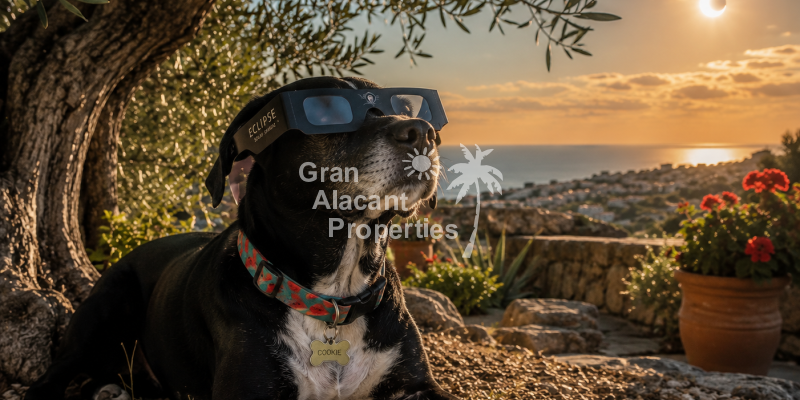
Miss Cookie would like us to point out that not everybody in the household has been waiting more than a century for an astronomical event. The good news is that dogs don't normally stare at the Sun. There is no reason to put eclipse glasses on your dog and absolutely no reason to encourage them to look upwards.
For most dogs, the eclipse itself is unlikely to be a major problem. The humans may be another matter. Crowds, excitement, unfamiliar places and changes in routine are more likely to upset a dog than the Moon passing in front of the Sun. If your dog is nervous around crowds, leave them somewhere cool and comfortable at home.
If they are joining your eclipse party, keep them securely on a lead in public, make sure they have water and shade, and watch for signs that they're uncomfortable.
And remember that your dog does not care if this is the astronomical event of the decade. If they would rather go inside and have a nap, let them.
Why not throw a last-minute eclipse party?
The timing could hardly be better. The eclipse starts at 19:40 and reaches maximum at 20:35. In Spain, we have a word for an astronomical event occurring at precisely the correct time for drinks and snacks: Wednesday.
Call a few friends. Put some drinks in the fridge. Find somewhere with a good western view and put out some easy pica-pica. Make sure everybody has proper eclipse glasses. "Total Eclipse of the Heart" is compulsory. "Here Comes the Sun" should probably wait until afterwards.
Set an alarm for about 20:25 so nobody gets distracted discussing the tortilla and misses the main event. Then stay outside for dinner.
There is another bonus tonight. August is Perseid season, so once it is properly dark, keep looking up. You may be rewarded with a shooting star or two as well.
Spain is really showing off this week.
Alicante has done this before
For our part of the Costa Blanca, there is a wonderful historical connection to solar eclipses. On 28 May 1900, a total solar eclipse crossed this area, and Elche became an international centre of astronomical observation. Scientists and astronomers travelled here to study the eclipse, bringing telescopes, cameras and other equipment to observe and photograph the event.
That eclipse also has a remarkable place in the history of moving pictures: footage taken during the 1900 eclipse is considered the earliest surviving film of a total solar eclipse. So when we're standing outside in Gran Alacant tonight with our eclipse glasses and phones, we're participating in a local tradition that stretches back more than a century.
And if that history interests you, the Biblioteca Pedro Ibarra in Elche currently has a special exhibition, "Eclipse / Eclipsi 1900", featuring books and historical documentation relating to the event.
And keep those eclipse glasses!
Do not throw them away tomorrow morning. Spain is in the middle of an extraordinary little golden age of eclipses. On 2 August 2027, another total solar eclipse will cross southern Spain. From our part of Alicante, we'll again experience a very deep partial eclipse.
And then comes the really interesting one for us. On 26 January 2028, an annular solar eclipse will cross the Valencian Community. An annular eclipse happens when the Moon passes directly in front of the Sun but is slightly too far from Earth to cover it completely. Instead, a brilliant circle of sunlight remains around the Moon: the famous "ring of fire."
So put your eclipse glasses somewhere safe when tonight is over. You're going to need them again.
Tonight's Gran Alacant eclipse cheat sheet
???? TODAY, Wednesday, 12 August 2026
???? Eclipse begins: 19:40
???? Maximum: 20:35
☀️ Eclipse magnitude: approximately 99%
???? Look: west-northwest
???? Sun height at maximum: only around 4° above the horizon
???? Sunset: approximately 21:00
????️ Eclipse glasses: YES, throughout the entire eclipse
???? Dogs: perfectly welcome if they're comfortable, but they don't need to look up
???? Drinks: strongly recommended
And perhaps the most important advice of all: don't experience the whole thing through your phone. Take a photograph or two if you can do so safely, certainly. But then put it down.
For a little while tonight, millions of people across Spain will be doing something humans have done for thousands of years. We'll stop what we're doing, look towards the sky and watch the Moon move in front of the Sun.
Some things are worth simply being there for.